

chapter3.4
The usefulness of an Ayurvedic Drug containing Eupatorium Ayapana in 50 cases of Dysfunctional Uterine Bleeding
Introduction
Dysfunctional Uterine bleeding is one of the commonest problems faced by Gynaecologists in India. The incidence is reported to vary from 12.6% to 23.1%. Uterine bleeding occurring at unexpected times or in excess of normal menstrual flow in the absence of organic or systemic disease is defined as Dysfunctional Uterine Bleeding.
Dysfunctional Uterine bleeding treated with haemostatics and hormones like oestrogen, progesterone, androgens, which on prolonged use, have a number of side effects. Here lies the usefulness of an indigenous drug which is both safe and effective.
COMPOSITION OF EACH TABLET
| Ingredient | Quantity |
|---|---|
| Ayapana (Eupatorium ayapana) | 60 mg |
| Asoka (Saraca indica) | 60 mg |
| Nagakesar (Mesua ferrea) | 30 mg |
| Godanti (Gypsum) | 30 mg |
| Kamboji (Breynia patens) | 90 mg |
| Jeevanti (Leptadenia reticulata) | 90 mg |
Ayapana herb contains an essential volatile oil and a neutral crystalline principle; its leaves contain an aromatic volatile oil and the dried leaves yield not less than 0.05% of the alkaloids, Ayapanin and Ayapin.
Asoka bark contains a large amount of tannin and colouring matter haematoxylin catechol. Godanti, the hydrated calcium sulphate is having astringent and haemostatic properties. Nagakesar has antibiotic activity.
Material and Methods
The clinical trial was carried out in 50 patients aged 16 to 45 years, with an established history of dysfunctional uterine bleeding. Patients were selected from the Department of Obstetrics and Gynecology, Government General Hospital, Guntur (Andhra Pradesh) during the years 1972 and 1973.
Before instituting the treatment, a thorough general and systemic examination and even dilatation and curettage were done to exclude any pathological condition of the uterus.
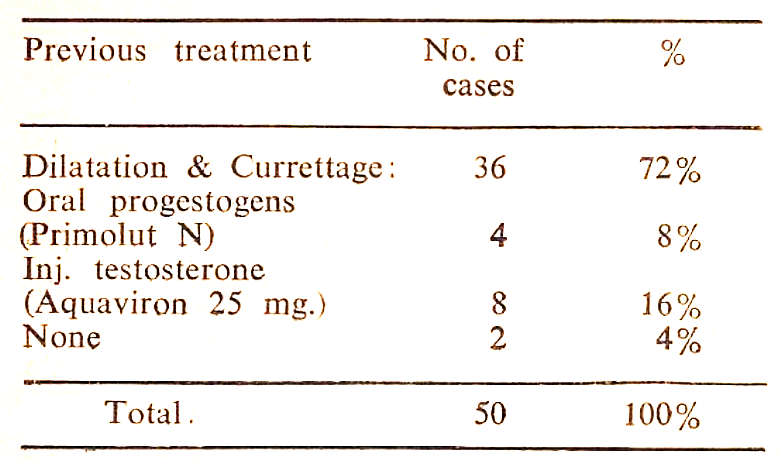
Most of them had been previously treated on usual lines, i.e. Dilatation and curettage and hormones but without benefit and the bleeding recurred.
In each case, endometrial biopsy was taken to study the nature of the response of the endometrium at the end of the treatment.
As a supportive treatment, haematinics and multivitamins were given. Bed rest was advised during bleeding episodes.
DOSAGE
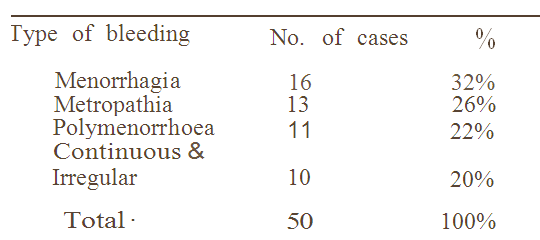
Those suffering from menorrhagia were given 2 tablets 3 times a day for 7 days, prior to the onset of menstruation; 11 cases of polymenorrhagia and 13 cases of metropathia were given one tablet 3 times a day for 30 days.
In both the groups the treatment was given for 3 cycles.
In 10 cases of continuous and irregular bleeding, they were given 2 tablets, three times a day, for 5 days. If necessary this was followed by the same dosage for another 5 days.
The patients were asked to come to follow-up every month when a detailed history regarding the amount and duration of bleeding was noted.
They were followed-up for a period of 6 months. If the patient did not respond to 3 months therapy, the treatment was continued for another three months. Patients who responded to treatment were observed for a further period of 6 months.
Results
The criteria for improvement were:
- Reduction in quantity of bleeding.
- Reduction in duration of bleeding.
- Change in irregularity of bleeding towards normal.
Response
1. Good: Complete relief of symptoms and reversal to regular periods. The bleeding decreased within 3 days and subsequent menstrual rhythm was regularised from the next month. No irregularity was found within 6 months of observation.
2. Fair: When bleeding decreased within one week and ceased completely within 10 days and rhythm was regularised from third cycle onwards.
3. Poor: When bleeding did not stop, in spite of 6 months course of therapy.
Observations and Analysis of Data
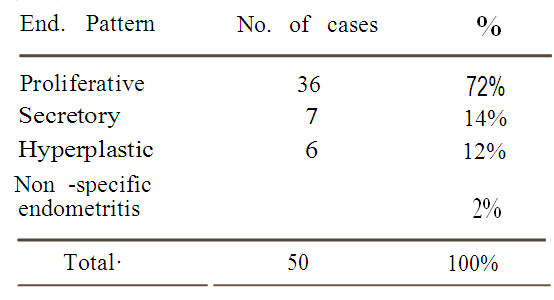
Histopathological findings of endometrium in 50 Patients. Most of the cases (72%) showed proliferative phase.
Menstrual History: Menorrhagia is the main presenting symptom (32%).
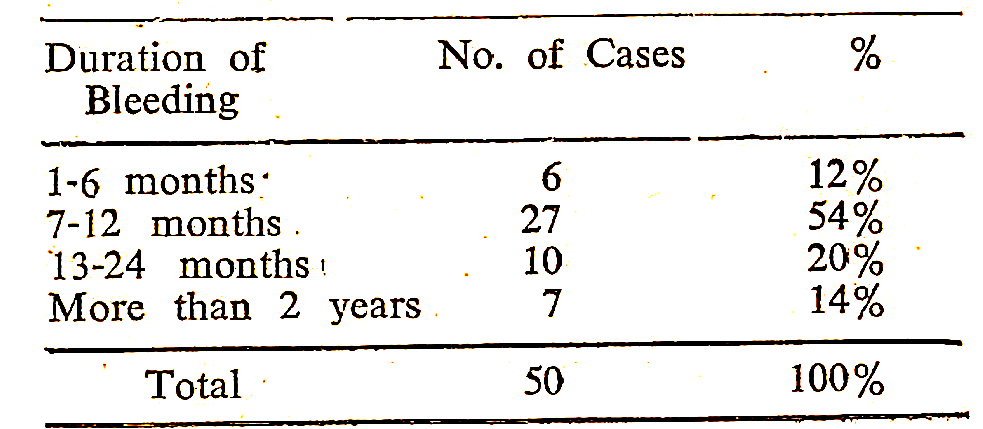
Duration of Bleeding
88% of Cases had the bleeding for more than 6 months.
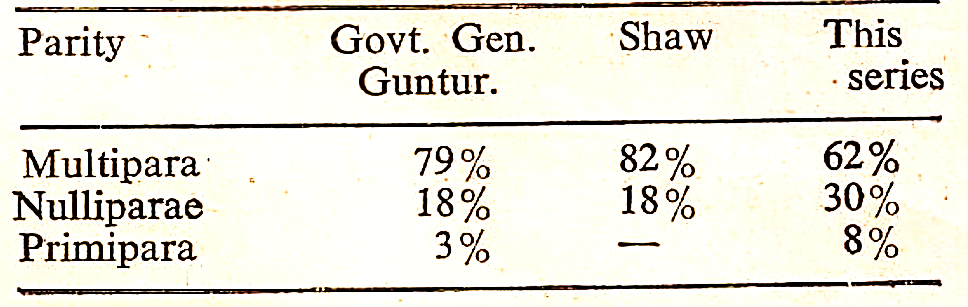
Parity Comparison With Other Authors
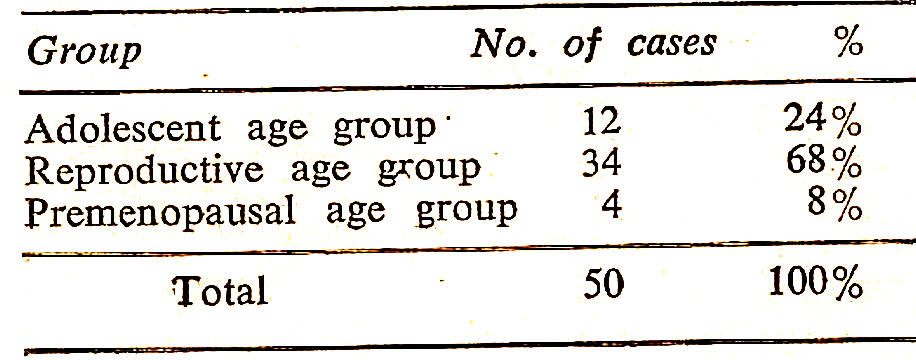
Distribution of Cases Among Different Reproductive Groups
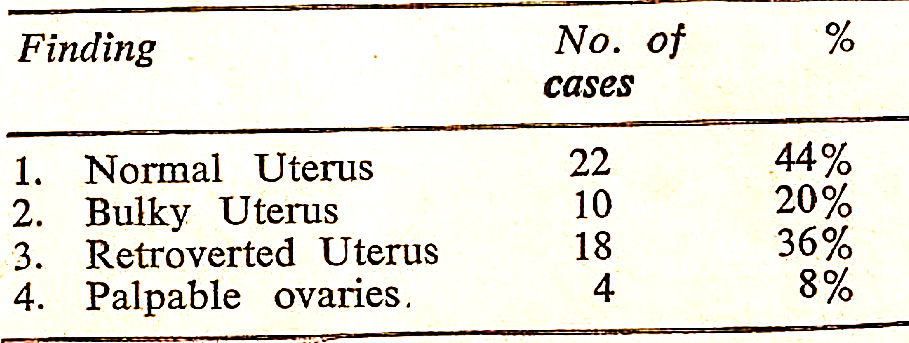
Pelvic examination Findings
Previous treatment
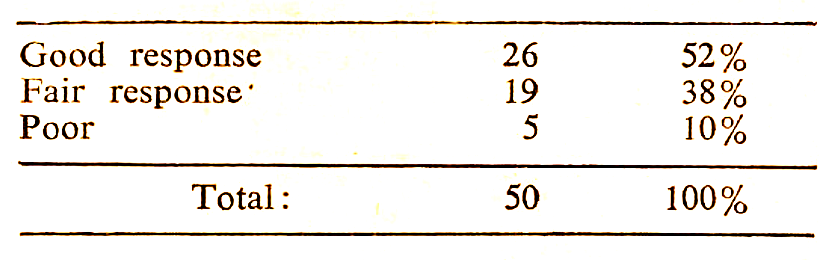
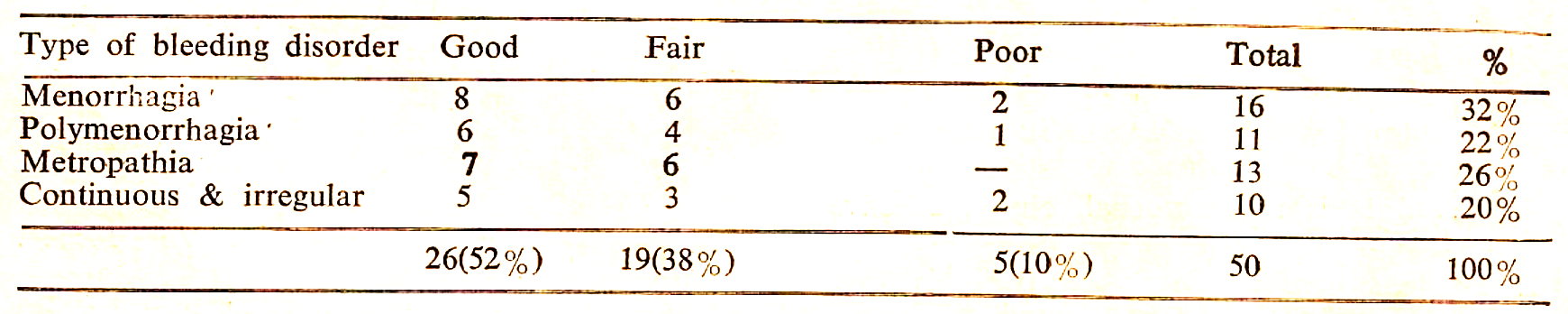
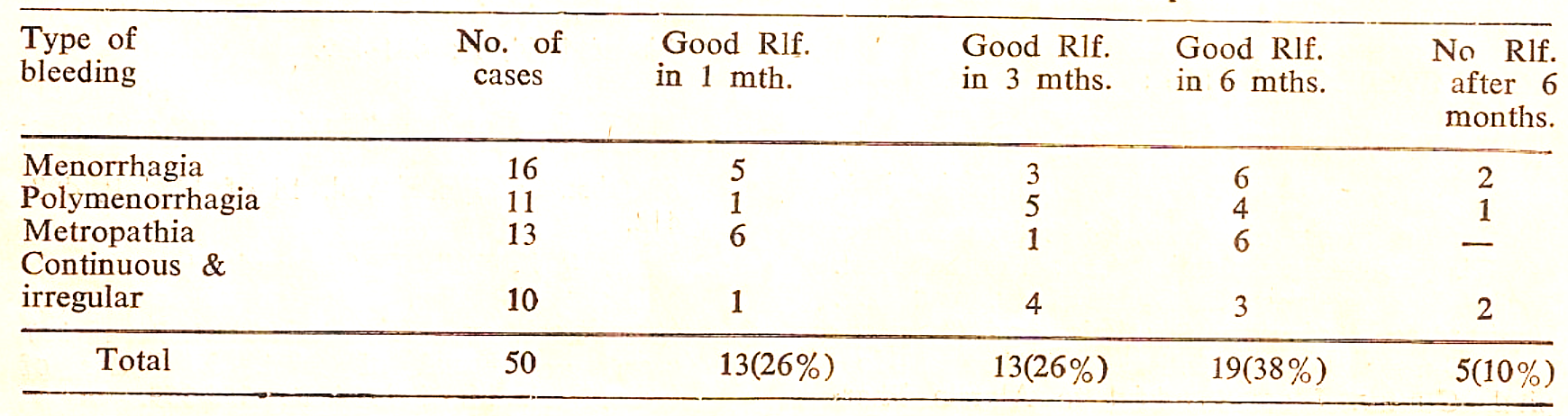
In 26 patients (52%) the response was good. All these patients responded after 3 months of therapy. 19 patients (38%) had reduced bleeding after 4 months of therapy and got cured after 6 months therapy.
Only 5 patients did not respond even to 6 months therapy. Out of these 5 patients, 3 were operated – 2 cases were of seedling fibroids and one case was of endometrial polypoidosis.
Out of the remaining 2 patients, one attained menopause and the other did not come after 6 months treatment.
On the whole, 45 patients (90%) responded favourably to treatment and had relief from their symptoms. (Table VIII).
It was noticed that the patients who responded best were of those suffering from menorrhagia and metropathia. (Table IX).
The endometrial biopsy was repeated after completion of therapy and it was found to be the same as before the treatment and no change was observed in the endometrium.
Side Effects
Only one patient complained of excessive nausea. No other side effect was noticed.
Discussion
The multiplicity of methods of treatment employed for Dysfunctional Uterine Bleeding evidence difficulties and disappointments. Styptics, various combinations of drugs and hormones including ovarian hormones, androgens, gonadotrophins, lactogen, thyroid extract, pitressin, vitamins, antimenorrhagic factor of liver, radiotherapy and operations, have all been tried with varying claims of success by different workers.
In the absence of exact knowledge of the aetiology of dysfunctional uterine bleeding and also the unsatisfactory results of treatments, the value of this Ayurvedic preparation with its haemostatic properties, and with assimilable calcium causing coordinated uterine contractions controlling excess of bleeding deserves attention.
The present therapy showed encouraging results in 90% of the patients in our series and proved helpful in some cases in avoiding surgical and drastic drug treatment.
Phadnis from Poona (1964), Mehta from Bombay (1964) and Javeri from Baroda (1965) and other authors have reported encouraging results with this therapy.
SUMMARY AND CONCLUSIONS
- The present study deals with the use of the combination containing E. Ayapana in the treatment of Dysfunctional Uterine Bleeding of 50 cases.
- In all these cases, the endometrial pattern was studied by biopsy before and at the end of the course and no change was found in the endometrium.
- Best results were obtained in cases of menorrhagia and metropathia.
- There were no side effects with this drug except nausea in one patient.
- The drug owes its effects to its haemostatic properties and uterine sedative action.
- The drug is non-hormonal, cheap, effective and safe.
- The cure rate in the present series is 90%; 45 patients out of 50 were cured within one to 6 months of therapy.
ACKNOWLEDGEMENTS :
My grateful acknowledgements to Dr. N. Subhdra Devi, M.D., FRCOG., Dr. A. V. Narayana Rao, M.D., Dr. A. Savitri, M.D.; Former Professors of Obstetrics & Gynaecology; Dr. C. Rani Hitavachani, M.D., Former Asst. Prof. of Obstetrics & Gynaecology, and Dr. Vani, M.D., student in Obstetrics and Gynaecology; Guntur Medical College and General Hospital, Guntur.
I am thankful to Alarsin Pharmaceuticals, Bombay, for the generous supply of the product containing Eupatorium Ayapana.
REFERENCES
- Bickers, Menorrhagia, Menstrual Distress, 1954.
- Bhattacharji, Saroj K; O. (Cal.), MRCOG, DGO. – “Dysfunctional Uterine Haemorrhage – Correlation of Endometrial Pattern with Clinical Behaviour.” – Journal of Obstetrics & Gynaecology of India, 14 of 1964, Page: 372-379.
- Browne J. and Browne J.C., Postgraduate Obstetrics & Gynaecology, 1973.
- Browne, Aleck, Wand Williams, Leslie – Recent Advances in Obstetrics and Gynaecology.
- Chakraborty, R.K., MD, DGO., and P. K. Devi, MS., FRCS., “Treatment of Puberty Menorrhagia with Hormones” – Journal of Obstetrics & Gynaecology of India, Vol. of 1970, Page 416-420.
- Charles Meleman – American Journal of Obst. & Gynec. Page 989-94: 1952.
- Chopra, R. – Indigenous Drugs of India, 2nd Ed. 1958.
- Claylee, Andrew and Browne – British & Gynec.
- Cope, E., MD, FRCOG: “PHYSIOLOGY OF ABNORMAL BLEEDING”, British Medical Journal, 5, June 1971 – P.573-575.
- Cope, Edward, MD., FRCOG: “Dysfunctional Bleeding” – British Medical Journal, 12, June 1971, P.631-632.
- Cope, Edward, MD, FRCOG: “Management of Abnormal Bleeding” – British Medical Journal – 19, June 1971; P:700-701.
- Darchman Isidore: American Journal of & Gynec. 212-95 – 1966.
- Dass, Anasuya, MRCOG and S. Chugh, DGO.: “Dysfunctional Uterine Bleeding – A clinico-pathological study” – Journal of Obst. & Gynec. of India: Vol. 14 No. of 1964 P:348-354.
- Dass, Anasuya, and R. K. Popli, MBBS: “Nor-Ethynodrel in Dysfunctional Uterine Bleeding” (A Preliminary Report) – Journal of Obst. & Gynec. of India, Vol. 14 of 1964, P:431-439.
- Dawn, S., DGO., MO, D. Phil (Cal.) MRCOG (Lond) – “Environment and Dysfunctional Uterine Haemorrhage”, Journal of Obst. & Gynec. Vol. 14 of 1964 P.408-412.
- Devi, K., MS, FRCS, and U.D. Sutaria MD: “Functional Uterine Haemorrhage (A clinical and Histological study of 357 cases)” – Journal of Obst. & Gynec. of India, Vol. 14 of 1964 P:355-359.
- Dey, Bhaskar Lal: “The study on the Haemostatic Behaviour of Ayapana and a few notes on” – Indian Drugs, Sept. 1973 – P:13-14.
- Fernandes, Winfred, MD, FCPS, and Kalyani Subrahmanyam, MD, DGO: “Gynaecological Problems in Teenagers”, Journal of Obst. & Gynec. of India, Vol. of 1971 P:53-59.
- Fluhmann – The management of menstrual disorders.
- Ghosh, K., MBBS, Dip. Borns., D. Phil Cal) and K.P. Sengupta, MBBS, D. Phil (Cal.) – Journal of Obst. & Gynaec. of India, Vol. of 1968 P-310-316.
- Ghosh, R – Pharmacology, Materia Medica and Therapeutics 20th Edition.
- Hamblen – Endocrinology of women.
- Jahagirdar, R., FRCS (Eng.), FRCS (Edin): “Place of indigenous drug Ayapon in Dysfunctional uterine bleeding.” – Paper read at XVI Conference of International College of Surgeons, Hyderabad, A.P. 2-4 Oct. 1970.
- Javeri (Sm) Veenaben, MD, DGO: “Treatment of Functional uterine bleeding – A clinical study with Ayapon” – Indian Practitioner; Vol. 18, No. 11 1965 P:783-786.
- Jeffcoate TNA – Abnormal and Excessive Haemorrhage from the uterus and vagina in “Principles of Gynaecology”.
- Joshi, K., MD. and D. H. Deshpande, MBBS. DB.: “Clinico pathologica study in 274 cases of Dysfunctional Uterine Haemorrhage” – Journal of Obst. & Gynaec. of India, Vol. 14 of 1964 P:360-371.
- Kanakadurga MD, MRCOG and Srinivasarao, MD: “A clinical and histopathological review of Dysfunctional Uterine Bleeding (One hundred and fifty cases)” – Journal of Obst. & Gynec. of India – Vol. 14 of 1964 P380-386.
- Khan, MD, MRCOG: “Dysfunctional uterine bleeding (Age group under 20 years)” – Journal of Obst. & Gynec. of India, Vol. 14 of 1964 P393-396.
- Keller J. – Modern Trends in Gynaecology.
- Kodkany Kamal B., MD, FCPS, DGO.: “Use of Ayapon in uterine bleeding after IUCD.” – The Indian Practitioner. Vol. 21 No. 12, Dec. 1968 P:901-903.
- Kupperman S – Diagnostic value of Endometrium in Menstrual abnormalities, human endocrinology.
- Lewis, TLT – Progress in clinical Obstetrics & Gynaecology.
- Mac Donald – Scientific basis of Obstetrics.
- Masani M. – Menorrhagia and D.U.B. – Text Book of Gynaecology.
- Mazer and Israel – Diagnosis and treatment of Menstrual disorders.
- Mehra, M.D.; P. K. Devi, MS, FRCS.
- N. Chakravarthi, MBBS, D. Phil and R. R. Chaudhury, MBBS, D. Phil; “Mast cells in the Endometrium in Dysfunctional Uterine Bleeding and postabortal bleeding.” – Journal of Obst. & Gynaec. of India, Vol. No. of 1970 P792 to 794.
- Mehrotra, G. MD, Krishna Mukerjee MS; Manjula Pandey, MS and V. Samant, MD; “Functional Uterine Bleeding – A review of 150 cases” – Journal of Obst. & Gynaec. of India: Dec. 1972 Vol. 27 No. 6 P:684-689.
- Mehtaji Shirin: “Puberty Menorrhagia” – Bombay Hospital Journal, 12, No. 2, April 1970 P:39-41.
- Meigs, Joe V and Sturgis, Somer H: Progress in Gynaecology, III.
- M. K. Krishna BA, MD, FRCOG: Ramani Sivaraman, MD, and K. Anasuya, MBBS, DGO, “Carbohydrate Metabolism in Dysfunctional uterine bleeding.” – Journal of Obst. & Gynaec. of India, Vol. 14 No. of 1964 P:343-347.
- Misra, Ananta and Surya Narayan Misra: “Studies on the Haemostatic effect of indigenous drugs” – Orissa Veterinary Journal, Vol. 3 No. 1. 1965.
- Mitra, K., MB. DGO. MO. (Cal.), MRCOG. PhD (Lond): “A study of the ovaries in Dysfunctional uterine haemorrhage” – Journal of Obst. & Gynaec. of India, Vol. 14 No. of 1964, P.398-406.
- Mukherji, B – The Indian Pharmaceutical.
- Nadka K M. – Indian Materia Medica – 3rd Ed. 1954.
- Nanivadekar S., MD, M.Sc.: “Ovral in menstrual disorders” – Current Medical Practice, Vol. 17, No. 6, June 1974 P:257-261.
- Nayar, U and R. Bijlani: “Physiological basis of abnormal bleeding”, Bombay Hospital Journal, 14, No. 1 Jan. 1972 – P.15-22.
- Edmund R and Jones G. O. – Novak’s Text Book of Gynaecology. Novak, Emil – Novak’s Obstetrics & Gynaecological Pathology.
Abstract of Part II of the thesis titled, “A Clinical & Histopathological study of Dysfunctional Uterine Bleeding (100 cases) and use of an Ayurvedic drug containing E. Ayapana in Dysfunctional Uterine Bleeding (50 cases)” submitted for M.D. (Obst. & Gynec.) of the Andhra University.